
PE spill pallets for small containers, drums, IBCs & shelving
Polyethylene spill pallets for the WHG-compliant placement of canisters, drums and IBC containers – from the flat 10-litre small-container tray to the 1,000-litre shelf tray with a grating. Chemical-resistant, UV-stable, low-maintenance. All made of PE / HDPE.
Small-container & pallet trays
Flat spill pallets for canisters, containers and small quantities (10–109 L, from €68.96) plus KWP-P pallet trays (20–100 L, from €68.66) with or without a perforated grid – BAUER Südlohn type made of rugged PE, for indoor spaces and covered stores.
Drum pallets for 2–4 × 200 L drums
PE spill pallets type WP for two or four 200-litre drums (220–410 L, from €392) – with or without a PE pallet, accessible from all sides for forklifts. Load capacity up to 1,250 kg. Also available as an HDPE variant with a grating (220–450 L, from €489).
IBC container trays
PE spill pallets type WP for one or two 1,000 L IBC containers (from €1,273) – with or without a PE pallet, accessible from all sides. Also available as an HDPE variant with a grating for 1 IBC (1,100 L collection volume). For the WHG-compliant placement of heavy bulk containers.
Shelf trays with a PE insert
Shelf trays in 1765 mm, 2165 mm, 2665 mm and 3265 mm lengths – with a PE insert (240–1,000 L, from €1,201), optionally with a grating. For installation in hazardous-material shelving and the WHG-compliant storage of chemicals, oils and water-polluting liquids on the shelf.

PE Spill Containment Tray KWP-P 20, made from durable polyethylene, 600x400x170mm, 20 liters, without perforated grate 🌟
- Dimensions (LxWxH): 600x400x170mm
- Collection Volume: 20 liters
- Weight: 4kg
Delivery time: 2-5 days

10L Drip Trays 570 x 390 x 53 mm for Small Containers 🌟
- Dimensions (LxWxH): 570 x 390 x 53 mm
- Collection Volume: 10 liters
- Weight: 1 kg
Delivery time: 5-10 Tage

PE Spill Containment Pallets Type KWP-P 800x400x170mm 30 Liters without Grating 🌟
- Dimensions (LxWxH): 800x700x170mm
- Collection Volume: 30 liters
- Load Capacity: 55kg
- Weight: 5kg
Delivery time: 2-5 days

PE Spill Containment Pallets Type KWP-P 800x600x200mm 40 Liters without Grate 🌟
- Dimensions (LxWxH): 800x600x200mm
- Capacity: 40 liters
- Load Capacity: 105 kg
- Weight: 7 kg
Delivery time: 2-5 days

28L Drip Tray 1200 x 550 x 50 mm for Small Containers 🌟
- Dimensions (LxWxH): 1200 x 550 x 50 mm
- Collection Volume: 28 liters
- Weight: 2.4 kg
Delivery time: 5-10 Tage

PE Spill Containment Pallets Type KWP-P 1000x600x200mm 60 Liters without Grate 🌊
- Collection Volume: 60 liters
- Load Capacity: 205 kg
- Weight: 10 kg
- Dimensions (LxWxH): 1000x600x200 mm
Delivery time: 2-5 days

30L Small Container Spill Tray for Liquids 980 x 600 x 85 mm 🛢️
- Dimensions (LxWxH): 980 x 600 x 85 mm
- Collection Volume: 30 liters
- Weight: 4 kg
Delivery time: 5-10 Tage

PE Spill Containment Pallets 600x400x170mm Type KWP-P 20 Liters with Grate 🛢️
- Collection Volume: 20 liters
- Load Capacity: 55 kg
- Weight: 4 kg
- Dimensions (LxWxH): 600x400x170 mm
Delivery time: 2-5 days
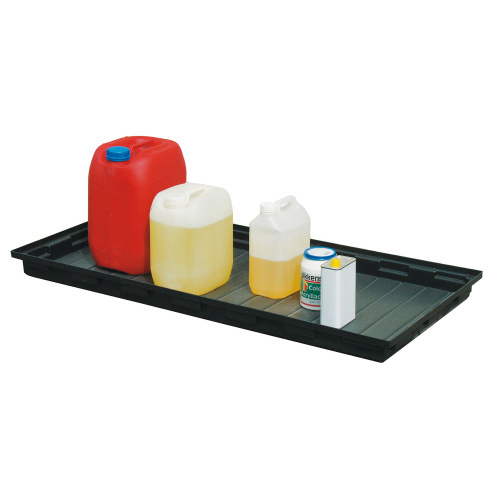
40L Small Container Spill Tray for Liquids 1300 x 620 x 80 mm 🛢️
- Dimensions (LxWxH): 1300 x 620 x 80 mm
- Collection Volume: 40 liters
- Weight: 5 kg
Delivery time: 5-10 Tage

45L, 75L, and 109L Spill Containment Trays for Small Containers 🛢️
- Collection Volume: 45 liters, 75 liters, 109 liters
- Container Type: Small container
Delivery time: 5-10 Tage

PE Spill Containment Pallets Type KWP-P 1200x800x195mm 100 Liters without Grating 🌟
- Collection Volume: 100 liters
- Load Capacity: 205 kg
- Weight: 14 kg
- Dimensions (LxWxH): 1200x800x195 mm
Delivery time: 2-5 days

PE Spill Containment Pallets for Pallets 800x400x170mm Type KWP-P 30 Liters with Grate 🌊
- Collection Volume: 30 liters
- Load Capacity: 55 kg
- Weight: 5 kg
- Dimensions (LxWxH): 800x400x170 mm
Delivery time: 2-5 days

Mini spill containment tray 70 liters made of HDPE
- Collection Volume: 70 liters
- Overall Dimensions (L × W × H): 810 × 635 × 230 mm
- Material: 100% HDPE
- High Chemical Resistance
Delivery time: 2-5 days

PE Spill Containment Pallets 800x600x170mm Type KWP-P 40 Liters with Grate 🌊
- Dimensions (LxWxH): 800x600x200mm
- Capacity: 40 liters
- Load Capacity: 105kg
- Weight: 7kg
Delivery time: 2-5 days

Mini Spill Containment Tray 100 Liters – HDPE with Flat Bottom
- Containment Volume: 100 liters
- Overall Dimensions (L × W × H): approximately 990 × 645 × 145 mm
- Material: 100% HDPE (High-Density Polyethylene)
- Flat Bottom – No Grating
Delivery time: 2-5 days

Mini spill containment tray 70 liters with legs – made from HDPE
- Collection Volume: 70 liters
- Overall Dimensions (L × W × H): 810 × 640 × 340 mm
- Material: HDPE / PP Grating
- Load Capacity: 100 kg
Delivery time: 2-5 days

PE Spill Containment Pallets for Pallets 1000x600x200mm Type KWP-P 60 Liters with Grated Cover 🌿
- Dimensions (LxWxH): 1000x600x200mm
- Collection Volume: 60 liters
- Load Capacity: 205 kg
- Weight: 10 kg
Delivery time: 2-5 days

Mini Spill Containment Tray 200 Liters – HDPE with Flat Base
- Containment Volume: 200 liters
- Overall Dimensions (L × W × H): approx. 1,190 × 805 × 150 mm
- Material: 100% HDPE
- Flat base for easy cleaning
Delivery time: 2-5 days

PE Spill Containment Pallets for Pallets 1200x800x195mm Type KWP-P 100 Liters with Grate 🛢️
- Dimensions (LxWxH): 1200x800x195mm
- Collection Volume: 100 liters
- Weight: 14kg
Delivery time: 2-5 days

PE Spill Containment Tray Type WP1220x820x33xmm with PE Pallet for 2x 200L Drums 🌟
- Maximum number of 200L barrels: 2
- Dimensions (LxWxH): 1220x820x330 mm
- Containment volume: 240 liters
- Weight: 26 kg
- Load capacity: 650 kg
Delivery time: 2-5 days

PE Floor Protection Tray 1260x860x150mm 150 Liters Type BWP-PE 150 🛡️
- Dimensions (LxWxH): 1260x860x150mm
- Capacity: 150 liters
- Weight: 20 kg
- Load Capacity: 1000 kg
Delivery time: 5-10 Tage

PE Spill Containment Sump Type WP 1225x820x450mm with PE Pallet - Accessible from All Sides for 2x 200L Drums 🚛
- Dimensions (LxWxH): 1225x820x450mm
- Collection Volume: 220 liters
- Weight: 26kg
- Load Capacity: 400kg
Delivery time: 5-10 Tage

Spill Containment Pallet for 2 Drums – 240 Liters made of HDPE
- Collection Volume: 240 liters
- Load Capacity: 650 kg
- Overall Dimensions (L × W × H): 1300 × 900 × 390 mm
- Material: 100% HDPE
Delivery time: 2-5 days

PE Spill Containment Tray Type WP 1280x1280x275mm with PE Pallet for 4x 200L Drums, 230L Containment Capacity 🌊🛢️
- Maximum number of 200L barrels: 4
- Dimensions (LxWxH): 1280x1280x275 mm
- Collection volume: 230 liters
- Weight: 35 kg
- Load capacity: 1250 kg
Delivery time: 2-5 days
Which PE spill pallet suits which application?
Canisters & small containers
For placing 5–30 L canisters, bottles and small containers: flat small-container spill pallets (10–109 L, from €68.96) – a low overall height (50–85 mm), a wide standing area (570–1300 mm). Ideal for indoor spaces, chemical stores and workshops without forklift access.
Euro and industrial pallets
For products stored on standard Euro pallets (800×1200 mm) or industrial pallets: KWP-P pallet trays (20–100 L) in matching dimensions (600×400 to 1200×800 mm). With a perforated grid as a spacer or without – depending on the product's requirements.
200 L steel drums & plastic drums
For one to four 200 L drums: PE trays type WP with a PE pallet (220–410 L, from €392) – accessible from all sides for forklifts, load capacity up to 1,250 kg. For 2 drums without forklift access: HDPE variant with a grating (240 L, from €489). Pay attention to a collection volume ≥ 10 % of the total volume.
IBC containers 1000 L
For the WHG-compliant placement of IBC containers: PE trays type WP for 1–2 IBCs (from €1,273) with or without a PE pallet, accessible from all sides. The collection volume of 10 % of the container contents (= 100 L per IBC) must be maintained. The HDPE variant with a grating (1,100 L, €1,106) offers the highest collection volume for a single IBC.
Hazardous-material shelving
For retrofitting or the initial equipping of hazardous-material shelving: shelf trays with a PE insert (240–1,000 L) in four lengths (1765/2165/2665/3265 mm) – with a grating for the shelf level or without for the floor level. Match the dimensions to the existing shelving – the internal dimensions of the frame determine the right PE insert.
PE vs. steel – when PE?
PE spill pallets are ideal for chemicals, acids, alkalis and AdBlue®, which would attack steel. For diesel, heating oil and mineral oils, both materials work – PE is lower-maintenance (no rusting, no coating needed) and lighter. Steel spill pallets are more rugged under mechanical loading and sometimes cheaper for heavy loads.
Frequently asked questions about PE spill pallets
The right PE spill pallet for your operation
Our specialist team advises you free of charge – on volume, dimensions, WHG requirements and the right version for your storage needs.
☎ Call +49 36071 924340 Request a quote